Another day, another big investment in online video in China. The recipient this time is Qiyi, an online video venture from Chinese search giant Baidu (s BIDU); it’s raised $50 million from Hulu backer Providence Equity Partners.
The news of Baidu’s interest in launching an online video site for premium licensed content broke in January, when Providence Equity Partners was rumored to have invested $60 million in the new entity. According to the site’s About page, Qiyi will provide “diversified licensed video content and launches various channels for hit TV shows, movies, documentaries, cartoons, music, variety shows, etc.” At the same time, Baidu says it is committed to abiding by Chinese copyright laws and government regulations to ensure quality of content and user experience.
Baidu isn’t the only firm to have raised significant cash to tackle the online video market in China. In December, online video competitor Youku raised $40 million in a funding round led by Chengwei Ventures, with existing investors Brookside (Bain) Capital, Maverick Capital and Sutter Hill Ventures also participating. So far, Youku has raised $110 million, and now employs more than 300 people.
But while Baidu’s Qiyi will focus exclusively on licensed content, Youku has a mix of licensed and user-generated content. In a video interview with NewTeeVee posted yesterday, Youku CEO Victor Koo said that his site’s content mix is about 70 percent licensed content vs. 30 percent that’s user-generated.
Providence Equity Partners joined the Fox Broadcasting (s NWS) and NBC Universal (s GE) joint venture Hulu with a $100 million investment in 2007. Unlike Hulu, which now counts Fox, NBC, and Disney (s DIS) as stakeholders, Baidu will remain the only other partner in the firm, and will retain a majority stake in Qiyi.
Related content on GigaOM Pro (subscription required):
Is Google’s China Problem a Groundswell of the Closed Internet?
What makes a country great? Its land, its people, its history, its culture, its belief systems or its soul? All of these, and so much more—including intangibles that most of us never think about. The United States is that country, unlike any other on the Earth. There is no need for Americans to flaunt it or be arrogant or condescending or aloof. Those are not the American way. Deep beneath the surface, there is love for people everywhere, and an appreciation of each person’s God-given gifts and uniqueness. In a recent interview, I said:
I believe in this country, and I believe in Americans of all colors, faiths and backgrounds. The United States is the only true melting pot in the world, with its populace representing a United Nations of the world’s peoples. Yes, we fight and we even discriminate, but when times are tough—like after 9/11—we come together as one nation, which makes this country so great and special. Also, all of us or our ancestors came here from somewhere else. Even the American Indians are descended from those who crossed the Bering Strait—or the “Bering land bridge”—according to anthropologists.[2]
Most of us spend a lifetime dealing with issues and challenges that we believe, rightly or wrongly, are not of our own making; and we react accordingly. Some are big, but most are small and petty, albeit each seems so important at the time. For example, last night I bought a new Apple iPod on which I loaded music and other data from my laptop, but I could not find the icon on my desktop this morning. I called Apple’s technical support line, and was routed to a fellow in India. He was very nice and courteous, but I told him that I wanted to speak with someone in the United States. When he said that he would let me talk with his supervisor, I thanked him but said no, and hung up and called Apple again. The same thing happened, so I tried a third time and a very nice woman came on the line named “Abby.” I detected a slight accent and asked where she was located, and she said the Philippines. I thought about hanging up a third time, but decided against it.
Abby was delightful, and really tried to help. Having been an Apple customer for about 20 years, I know how diligently she tried. Finally, she routed me to Amy, who turned out to be located in Boise, Idaho. Amy was delightful too; and we tried everything, but nothing worked because the “Made in China” iPod is apparently defective and needs to be replaced. In the course of our discussions, I learned that Amy hailed from California, where I was born and raised. Having had bad experiences with HP recently—where Amy’s husband has worked—in terms of its nonexistent customer support, I was pleased to tell Amy how I had gone through Apple’s ups and downs, but have been generally quite pleased with its telephone support. It has kept me in the fold and a loyal Apple customer through thick and thin. Something struck me in the gut though, about companies like Apple farming out calls to India, the Philippines and other countries. It just seemed very un-patriotic. It meant the loss of jobs that might have gone to Americans; and it was the first time that I found Apple doing it.
If I had purchased Apple stock at about $12 per share many years ago, I would have made out like a bandit. If I had bought stock in Ford when it reached a low of $1.01 in November of 2008, which was not too long ago, I would done very well. Ford has announced plans to hire more American workers; its new cars are great looking; and their quality is apparently superb.[3] Despite the fact that the U.S. may be in the “doldrums” for the rest of this decade, I have been pleased to tell friends and acquaintances that Ford is back, or so it seems, just like Apple came roaring back. My first four cars were Fords, before I switched to foreign brands—with two Chevrolets thrown in—and it is nice to think about Ford once again and to have an American automaker to be proud of. Lots of people are avoiding cars from Barack Obama’s “Government Motors” and Chrysler, and I share their views.
Whether it is a computer-related product or a car or almost anything else in life, there is a newfound pride in buying American that is surfacing in this country. Will it result in harmful protectionism that sent the global economies into a tailspin during the 1930s? I do not believe so because at the very least, complicated products like cars and computers often have parts that are made abroad. However, as times get tougher, Americans and others may buy their own country’s products before turning abroad. This is human nature; or their decisions may be dictated solely by price not sentiment. Apple’s iPod and its computers are made in China, but even that might change—although it seems unlikely anytime soon.
In April of 2009, I wrote: “America and other nations are in uncharted waters [economically, politically, and in other ways]; and their politicians may face backlashes from disillusioned and angry constituents that are unprecedented in modern times.”[4] Even harder days are ahead, and politicians may experience electoral “bloodbaths.” These will be years of taking stock, and of being thankful for the little things—for families and helping others. The limits of hedonism, godless secularism, and paying homage to the false gods of materialism will become self-evident. We may opt for simpler lives because we have to, and because we come to like and prefer a return to the basics.
When I decided that I wanted to work on Capitol Hill after spending two years in the Army, rather than rejoin a prestigious San Francisco law firm where I could make more money, I tried to get a job with then-U.S. Senator Alan Cranston from my home State of California. To my surprise and disappointment, his staff was headed by a fellow from New York who apparently wanted to propel Cranston into the foreign policy arena, and was less interested in hiring Californians like me. Hence, I pounded the Senate corridors and learned that then-U.S. Senator Edward W. Brooke—the first black senator since Reconstruction after the U.S. Civil War, with Barack Obama being the third—was hiring an attorney for the Senate Banking Committee.
I was hired by his chief of staff, Dr. Alton Frye, without ever having met the senator. I was honored that a white man from California was working for a black man from Massachusetts, but that is how America works. I went on to write the “Brooke Amendment” relating to public housing; and the national “Housing Allowance” that morphed into the Section 8 housing program, which has helped millions of Americans. The nicest thing that some people might say about me is that I am “outspoken.” Ed Brooke put it another way one day, when he said that I lacked “tact.” Perhaps this is the beauty of being an American. Each of us can speak our mind on any and every issue, without qualms about doing so.
I criticize President Obama regularly, often in scathing terms, but I almost voted for him. Even though I disagree with almost everything he does, because I am much more conservative than he will ever be, I would prefer him any day of the week to a leader like Russia’s murderous dictator-for-life Putin.[5] Perhaps I will never forget the way Obama wrote lovingly about his mother and his maternal grandparents, “Toot” and “Gramps,” in his book “Dreams from My Father.”[6] Yet, after working in Washington, D.C. for 21 years nonstop, the one lesson I learned is that government does not work; and the Obama presidency is a shining example of that. Only the Pentagon—where I spent two years as an Army Officer—and our military are remotely efficient and effective. The rest of government is a vast “wasteland,” even though there are good people working at all levels of government.
America is magnificent geographically, whether one thinks about the Grand Canyon, Yellowstone, Yosemite and other breathtaking parks, or its deserts, mountains, lakes, inland waterways and coastlines. Its metropolitan areas unparalleled, be it New York City or San Francisco, or thousands of cities and towns in between. Its people are like a rainbow, with diversity undergirding all. Its culture is rich because of the many cultures that have been blended into the American experience, which is unique in all the world. Its belief systems are as varied as there are colors in the rainbow. And its soul . . . ah yes, its soul . . . embraces the souls of more than 300 million people, woven together into a rich tapestry of life.
When we have decisions to make or feel that we are being called in a particular direction, our strength comes in putting our faith in God within and trusting the guidance we receive through prayer, intuition or love. As individuals and as a country, we walk by faith not by sight. Yes, America is great . . . from sea to shining sea—and deep in the Pacific where volcanic peaks of the Hawaiian Islands loom, and in the majestic northernmost reaches of Alaska’s tundra, and in the azure Caribbean too. God blessed us beyond belief, although we take it for granted much of the time. Everyone does. This is human nature. After all, we are not perfect. Neither is America. Only God is.[7]
[1] Timothy D. Naegele was counsel to the U.S. Senate Banking Committee, and chief of staff to Presidential Medal of Freedom and Congressional Gold Medal recipient and former U.S. Senator Edward W. Brooke (R-Mass), the first black senator since Reconstruction after the U.S. Civil War. He practices law in Washington, D.C. and Los Angeles with his firm, Timothy D. Naegele & Associates (www.naegele.com). He has an undergraduate degree in economics from UCLA, as well as two law degrees from the School of Law (Boalt Hall), University of California, Berkeley, and from Georgetown University. He is a member of the District of Columbia and California bars. He served as a Captain in the U.S. Army, assigned to the Defense Intelligence Agency at the Pentagon, where he received the Joint Service Commendation Medal. Mr. Naegele is an Independent politically; and he is listed in Who’s Who in America, Who’s Who in American Law, and Who’s Who in Finance and Business. He has written extensively over the years. See, e.g., www.naegele.com/whats_new.html#articles
[2] See http://www.philstockworld.com/2009/10/11/greenspan’s-legacy-more-suffering-to-come/ and http://seekingalpha.com/instablog/2951-ilene/31177-interview-with-timothy-d-naegele
[3] See, e.g., http://finance.yahoo.com/q/hp?s=F&a=00&b=3&c=2008&d=01&e=2&f=2010&g=m; see also http://www.ford.com/about-ford/news-announcements/press-releases/press-releases-detail/pr-ford-kicks-off-2010-with-24-31945 and http://online.wsj.com/mdc/public/page/2_3022-autosales.html#autosalesE
[4] See http://www.realclearpolitics.com/news/tms/politics/2009/Apr/08/euphoria_or_the_obama_depression_.html
[5] Compare http://naegeleblog.wordpress.com/2010/01/20/the-end-of-barack-obama/ and http://naegeleblog.wordpress.com/2010/01/19/emp-attack-only-30-million-americans-survive/ and http://naegeleblog.wordpress.com/2010/01/01/barack-obama-america’s-second-emperor/ and http://naegeleblog.wordpress.com/2009/12/26/obama-in-afghanistan-doomed-from-the-start/ and http://naegeleblog.wordpress.com/2009/12/05/is-barack-obama-a-racist/ with http://naegeleblog.wordpress.com/2010/02/09/russias-putin-is-a-killer/
[6] See Obama, “Dreams from My Father” (paperback “Revised Edition,” published by Three Rivers Press, 2004), pp. xii (“[S]he was the kindest, most generous spirit I have ever known, and . . . what is best in me I owe to her”), 89 (“[Toot and Gramps] had sacrificed again and again for me. They had poured all their lingering hopes into my success. Never had they given me reason to doubt their love; I doubted if they ever would”), 343 (“I looked out the window, thinking about my mother, Toot, and Gramps, and how grateful I was to them—for who they were. . . .”); see also http://naegeleblog.wordpress.com/2009/12/05/is-barack-obama-a-racist/
[7] Some years ago, I had a law student from UCLA who worked for me as a law clerk doing research and legal writing. He made a small mistake in a brief, but one that I considered important. I jumped all over him. He had worked in Saudi Arabia as an engineer before coming to law school; and he stopped me, and asked if I knew how the Saudis made Oriental rugs.
Some were made by hand and others by machines, he said, but in every case there was an intentional mistake inserted somewhere in each of the rugs. He asked if I knew why, and I said no. He said the Saudis believe that only Allah—or God—is perfect; and of course I believe that too. Since then, when I have jumped all over myself for making mistakes, or thought about criticizing others, I have recalled his story.
Forever Lily: An Unexpected Mother’s Journey to Adoption in China by Beth Nonte Russell
Book description~
When Beth Nonte Russell travels to China to help her friend Alex adopt a baby girl from an orphanage there, she thinks it will be an adventure, a chance to see the world. But her friend, who had prepared for the adoption for many months, panics soon after being presented with the frail baby, and the situation develops into one of the greatest challenges of Russell’s life. Russell, watching in disbelief as Alex distances herself from the child, cares for the baby — clothing, bathing, and feeding her — and makes her feel secure in the unfamiliar surroundings. Russell is overwhelmed and disoriented by the unfolding drama and all that she sees in China, and yet amid the emotional turmoil finds herself deeply bonding with the child. She begins to have dreams of an ancient past — dreams of a young woman who is plucked from the countryside and chosen to be empress, and of the child who is ultimately taken from her. As it becomes clear that her friend — whose indecisiveness about the adoption has become a torment — won’t be bringing the baby home, Russell is amazed to realize that she cannot leave the baby behind and that her dreams have been telling her something significant, giving her the courage to open her heart and bring the child home against all odds.
“Will you take her?” is not a question you’d expect to hear your best friend ask, who you’ve accompanied to China, to help her adopt a baby…
That’s the basic storyline here. Alex realizes once she gets to China, and actually comes face to face with her brand new adoptive baby that it’s too much for her to manage. The book then vaguely discusses the legalities of their options. About 1/3 of this book was enjoyable. Another 1/3 was filler dream sequences, and the other 1/3 was flashback scenes.
The lack of continuity in this book fell flat for me pretty early on. Maybe because I’m soaking books up this year like a sponge, I had high hopes and expect a book to grip me immediately. There are SO many amazing books on my ‘to be read’ (TBR) list, I don’t want to spend time reading mediocre books. Sure, I was roped back in when the twist showed up, but it was short lived. I wanted to like it. I really did. I am so intrigued by the international adoption process and was hoping to learn more about a topic I previously knew nothing about. I love challenging myself to learn about foreign topics. Reading is a great way to do this. But alas, I’m still on the hunt. Unfortunately, when page 2 began a string of hokey dream sequences that reared their ugly head what seemed like every other page, all momentum was lost. Any hope of rising action was lost. I don’t recommend this book and I feel bad for saying that. I expected to learn more about the impetus behind the couple deciding to actually adopt, and the mechanics of the adoption process because it would have given the reader a better insight as to just how in the world Alex could have changed her mind at the drop of a hat.
Have you read a great book on international adoption? If so, please drop me a comment below, I’d love to give this topic a second chance!
2/5 stars
12 down, 40 to go!
In progress: Memoirs of a Geisha (audiobook), The Girl’s Guide to Being the Boss Without Being a Bitch
One-month-old South China tiger cub Niuniu is seen at a zoo in Luoyang, Henan province, February 20, 2010. The Chinese New Year began on February 14th and according to the Lunar calendar, it is the Year of the Tiger. REUTERS/China Daily (CHINA – Tags: ANIMALS SOCIETY) CHINA OUT. NO COMMERCIAL OR EDITORIAL SALES IN CHINA
Drunken frat boys excluded, most Americans in city environment will do the pee dance all the way down the street in a desperate attempt to sneak into some McDonald’s undetected, lest, of course, they be forced to order off the dollar menu. The horror! The Chinese though, men, some women, and especially children, will not hesitate to drop trow and go. Now, this one might largely regional. No man that wishes to keep his member would dare whip it out in T’ianamen Square. The rather scary looking soldiers are certainly something to think about.
BUT if you are in any backwater or non-westernized city, bring the hand sanitizer. Believe me, the New York subways are squeaky clean in comparison.
John Smith started the day early having set his alarm clock (MADE IN JAPAN) for 6 a.m.
While his coffeepot (MADE IN CHINA) was perking, he shaved with his electric razor (MADE IN HONG KONG).
He put on a dress shirt (MADE IN SRI LANKA ), designer jeans (MADE IN SINGAPORE) and tennis shoes (MADE IN KOREA) After cooking his breakfast in his new electric skillet (MADE IN INDIA) he sat down with his calculator (MADE IN MEXICO) to see how much he could spend today…
After setting his watch (MADE IN TAIWAN) to the radio (MADE IN INDIA) he got in his car (MADE IN GERMANY) filled it with GAS (from Saudi Arabia) and continued his search for a good paying AMERICAN JOB. At the end of yet another discouraging and fruitless day checking his Computer (made in MALAYSIA), John decided to relax for a while. He put on his sandals (MADE IN BRAZIL), poured himself a glass of wine (MADE IN FRANCE) and turned on his TV (MADE IN INDONESIA), and then wondered why he can’t find a good paying job in AMERICA.
AND NOW HE’S HOPING HE CAN GET HELP FROM A PRESIDENT MADE IN KENYA!
Remember “not wood wood”? That is how I feel about Guangzhou. I know that I was in China. The map tells me so. The fact that I could not understand people or read signs tells me so. Yet, walking around it did not look like the China I have come to know as home. That was so cool, to experience a completely different side of China. Here there are way more western influences. Sure Beijing has McDonalds or KFC on every corner. Western restaurants and shops, but it looks like China. The China you see in pictures and movies. Naturally though this is why I chose Beijing, it the old China. This is where the history is. In Guangzhou there are western influences in the architecture. When we were in a shop, there was no bargaining. The listed price was the price, She Ma! (one of my favorite Chinese phrases, I use it daily!)
This of course makes sense. Guangzhou is located on the Pearl River which feeds to the Pacific. It is centrally located, nice neutral weather (usually) and easy travel. This of course made it a logical location for western countries to set up trade locations. Want to attempt to colonize? Why not enjoy the climate and beautiful hills while you do it? Want some opium, perhaps fight a war for it, well Guangzhou has all your opium and warring needs. Walking around this city the western presence as the city developed is evident. On Shaiman Island I thought I was in the old south and not China. Large brick buildings and pillars. Double sided stairs leading to wrap around porches. Large old trees moss hanging from the branches.
Throughout the city you would walk along, store and restaurant fronts look like China, especially when you see that you can get octopus balls or grilled baby snake on a stick, but look up. The windows are stained glass. There are bay windows with arches. Maybe some molding. Perhaps it is not communist cinderblock. It was a very cool mix of east meets west. When I say that it was not China China, I mean in appearance only. Everything about this city was what I have come to know as China.
Strengthening China’s military presence in Latin America is one of the many manifestations of Beijing’s increased activity on the international stage. Arms sales is a subset of the Chinese military’s growing involvement in Latin America. Yet, Chinese arms sales represent a small portion of its military sales and Latin America’s arms purchases from around the globe. In an arms buyer-seller relationship, the benefits of increased sales do not reside exclusively with the seller, which in this case is China. Latin American governments are also seeking to diversify their arms purchases to defend national interests, including achieving measures of autonomy beyond its relations with Washington—the predominant power in the region. While Beijing’s presence around the world is increasingly noteworthy, Latin America’s goal of establishing itself as a truly sovereign region is an equally important factor.
Defense of Free and Independent Taiwan
Taiwan’s International Legal Status Is Undecided
When Japan concluded San Francisco Peace Treaty in1952, Japan renounced territoriality of Taiwan.However, Japan never returned nor granted it to Republic of China.
After that, international legal status of Taiwan became undecided. And it is undecided still now. Republic of China, a government in exile, has been ruling Taiwan, but it lacks legitimacy to rule Taiwan.
Many misunderstand the U.S. ”One China Policy.” That simply means that the U.S. admits only one China. It doesn’t mean the U.S. admits that Taiwan is a part of China.
Japan neither has approved of One China Doctrine of Communist China, therefore, nor of annexation of Taiwan by Peoples Republic of China.
By exercising right of self-determination, people of Taiwan can build their own independent nation. International law allows them to do so.
…………………………………………………
Defense of Free and Independent Taiwan
[Ch-SAKURA February 16, 2010]
I awoke an hour before my 9:30 and got on netflix and looked for shit. I found quite the little gem of awesomeness. the complete series of Top Cat! best cartoon show. ever. period. I added them to my queue like that. I am excited. I go to my 9:30 and 15 minutes in I stumble over an answer about China and he misinterprets what I was trying to say so it seems like I was wrong (I wasn’t, I simply failed to correctly articulate what I meant). I decide to shut up for the rest of class and they get into a discussion about total and limited war and guerilla war vs. terrorism. I have good points but I withhold them and the class discussion suffered. I have exacted my revenge on them for not acknowledging my superiority.
I then go to my 11:00 and almost get caught for cheating on our first test. It was easy but I just wanted to check all my answers against Jerry, especially if I wasn’t positive. We go to lunch and then bump in to Caleb and Rob and others. I have some decent chicken nuggets and we have the most heated argument I have had in a long time over what is the difference between a test, a quiz and an exam. It was fucking intense.
After lunch I return to me room and watch last weeks episode of House. It depicts a day in the life of Cuddy while House’s patient exists on the periphery, much like the episode from earlier this season about Wilson. I thoroughly enjoyed the episode and thought it was really interesting to see things from her point of view. by the time it was over I had missed most of my 2:00. I watched a little Family Guy and then I watched the Llama Song for maybe 20 minutes straight. I lost an I.Q. point or two from that.
After a while I wandered over to grab some dinner and had some pretty good mashed potatoes and gravy, some decent chicken and the absolute worst corn I have ever had. it was like yellow paper soaked in corn juice and folded up like triangles. It was disgusting. After Dinner I return and watch some TV here and there then I find An Evening with Kevin Smith online and watch it. The thing fucking blew my mind. I re-awoke my latent love for his body of work and restored my dream of becoming a screenwriter and producer. Kevin Smith is an inspiring character for all of us who are fat and lazy and don’t really give a shit about what we are supposed to.
After this I go and bug scott about it for a while and then I get some dinner and watch an episode of south park.
Memento. I finally watched it. It absolutely blew my fucking mind. Christopher Nolan is an absolute genius. basically the film is about a man who is unable to form new memories. He received a head wound from the man (or men) who raped (and may have killed) his wife. He swears to exact revenge but his inability to form new memories complicates things. The film is presented in a non-linear form with two distinct sets of scenes that make up the story line of the film. The color scenes begin at the story’s end with the main character, Leonard having just killed the man he is looking for. these scenes progress in reverse chronological order while another set of scenes is presented in black and white. these scenes are the earliest chronologically and appear in order. they two story line converge at the end of the film in a shocking twist that leads us to question everything that we have just seen. It is a mind-bending experience that kept me on the edge of my seat and I recommend this movie to anyone.
As some of you may have noticed for some time now there has a little image that is linked to Bibles Unbound, located to the right of my page. No I am not getting paid to put adds on my weblog. Bibles Unbound, sends bibles out in many languages to people in country’s where Christians are being persecuted. Such as in China where the government has control over churches. Telling the churches over there what to say and to promote the actions of the government, evens if it goes against scripture.
As someone who understands the damage this does and being for the separation of church and state. Doing what I can to get bibles into the hands of Christians and even in to the hands of underground churches that are trying to be free from government control is important to me. That is why I support Bibles Unbound and hope you will to.
Please take the time and visit their site. And help Christians that really are experiencing persecution.
Several years ago, I met with the Deputy Director of the Policy Planning staff of China’s Ministry of Foreign Affairs, and I asked him what he was working on — and what China’s grand strategy was.
His reply: “We are trying to figure out how to keep you Americans distracted in small Middle Eastern countries.”
It’s pretty memorable when one can joke and be truthful at the same time. China has had opportunities throughout the world open up to it easily — mostly because of systemic American inattention to much else beyond its war slogs. The Obama administration, which in its first year in office, has managed high level presidential and cabinet level face time with leaders around Asia, Africa, Latin America, and the Middle East has done a lot to correct the impression from the G.W. Bush years that America has completely checked out from the rest of the world — but there still is a sense that American pretensions in the world are more veneer than real.
Now read in full (on the extended page) a short, brilliantly written report titled “Strategic Contraction Replaces Arrogance: Chinese Analysis of the Quadrennial Defense Review” by Li Shuisheng at China’s Academy of Military Science on the Pentagon’s recently released Quadrennial Defense Review.
This is a very sobering “offshore perspective” on American power.
The introduction starts with a quick tip of the hat to the Obama administration for greater pragmatism and less arrogance than the George W. Bush years – but also says that Obama’s course is leading to the strategic contraction of the U.S.:
After the United States was bogged down in the Afghanistan War for more than eight years and in the Iraq War for more than seven years, in early February, the Obama administration published its first “Quadrennial Defense Review” (QDR). This was a report submitted to US Congress by the US Department of Defense every four years as required by law, and was also a framework document for the future building of the US military.Against the background of being deeply mired in “one crisis and two wars”, this year’s report somewhat restrained the usual “arrogant style” appearing in the previous QDR reports, epitomized the more pragmatic defense policy pursued by the Obama administration, manifested the trend of the United States’ strategic contraction to a certain extent. The report also revealed some noteworthy new changes in the US military building.
The author also sees what this writer has argued: that American obsession with Afghanistan and an ever-expanding quest to stamp out Islamic insurgencies will “further chip away at the United States’ strength, aggravate its strategic adversity, and increasingly narrow the room for maneuvers on other issues.” The author writes:
The report, for the first time, mentioned that winning the currently ongoing wars was a priority task for the US military, and also the top priority in the consideration of the US Department of Defense on the defense budget, the defense policy, and military modernization. To stress the importance of winning the current wars, the report took this as the primary objective of the US defense strategy. While the counterterrorist wars lasted over a long time in an undecided condition, the US military actually faced the question: Which should be the priority, winning the current wars or coping with future threats?In the period of Rumsfeld, the US military stressed that both sides were priorities, but the efforts for coping with future threats was put to a more important position, and stress was actually laid on speeding up the military transformation through the counterterrorist wars. However, with the continuing worsening the battlefield situation in Iraq and Afghanistan, the US military changed this line of thinking, and laid greater stress on winning the current wars and coping with the instant threats. In April 2009, US Secretary of Defense Robert Gates pointed out in a speech at the US Naval War College that the primary task of the Department of Defense was to prevail in ongoing wars rather than just continuously making war preparations.
The reasons for the change of the US military’s thinking lay in following factors. First, as the current wars dragged on over a long time without a decisive outcome, this would further chip away at the United States’ strength, aggravate its strategic adversity, and increasingly narrow the room for maneuvers on other issues.
The full essay follows:
PRC Daily Views: US Military Strategy As Per DoD Quadrennial Defense Review Beijing Zhongguo Qingnian Bao Online in Chinese – 12 Feb 2010
“US Arrogance Replaced by Strategic Contraction: Trends of US Military Strategy As Drawn From the ‘Quadrennial Defense Review Report”
by Li Shuisheng, Academy of Military Science
After the United States was bogged down in the Afghanistan War for more than eight years and in the Iraq War for more than seven years, in early February, the Obama administration published its first “Quadrennial Defense Review” (QDR). This was a report submitted to US Congress by the US Department of Defense every four years as required by law, and was also a framework document for the future building of the US military.
Against the background of being deeply mired in “one crisis and two wars”, this year’s report somewhat restrained the usual “arrogant style” appearing in the previous QDR reports, epitomized the more pragmatic defense policy pursued by the Obama administration, manifested the trend of the United States’ strategic contraction to a certain extent. The report also revealed some noteworthy new changes in the US military building.
Prevail in the Current Wars, Move Out of the Strategic Adversity
The report, for the first time, mentioned that winning the currently ongoing wars was a priority task for the US military, and also the top priority in the consideration of the US Department of Defense on the defense budget, the defense policy, and military modernization. To stress the importance of winning the current wars, the report took this as the primary objective of the US defense strategy. While the counterterrorist wars lasted over a long time in an undecided condition, the US military actually faced the question: Which should be the priority, winning the current wars or coping with future threats?
In the period of Rumsfeld, the US military stressed that both sides were priorities, but the efforts for coping with future threats was put to a more important position, and stress was actually laid on speeding up the military transformation through the counterterrorist wars. However, with the continuing worsening the battlefield situation in Iraq and Afghanistan, the US military changed this line of thinking, and laid greater stress on winning the current wars and coping with the instant threats. In April 2009, US Secretary of Defense Robert Gates pointed out in a speech at the US Naval War College that the primary task of the Department of Defense was to prevail in ongoing wars rather than just continuously making war preparations.
The reasons for the change of the US military’s thinking lay in following factors. First, as the current wars dragged on over a long time without a decisive outcome, this would further chip away at the United States’ strength, aggravate its strategic adversity, and increasingly narrow the room for maneuvers on other issues.
Second, winning the current wars was directly related to the US strategic interests. The US military held that failures in Iraq or Afghanistan would cause a disastrous impact on the United States’ reputation and credibility. The United States cannot just concentrate on making preparations for conventional or strategic conflicts in the future and neglect the necessity of winning the ongoing battles for the time being.
Third, winning the current wars was also a matter concerning the US military’s capability of coping with conventional threats in the future. The US military held that in a fairly long period to come, the pattern of war that they might be facing would be a kind of composite irregular warfare, the “age of lasting conflicts” with non-state, irregular, and lethal adversaries would not come to an end in the near future, and the current wars were actually the “next war”.
Play Down Challenges From Large Powers, Give Prominence to Regional Threats
In both the 2006 “Quadrennial Defense Review” and the 2008 “National Defense Strategy”, the United States laid great stress on the challenges posed by new rising big powers to the United States. However, the latest “Quadrennial Defense Review” basically did not mention this issue, and turned to give prominence to regional threats.
The report took “deterring and defeating aggression in anti-access environments” as one of the six core capabilities of the US military. When commenting on the report, the chairman of the Joint Chiefs of Staff pointed out the two strategic tasks for the US military: One was to thoroughly defeat and destroy the terrorist organization of Al-Qaeda in Afghanistan and Pakistan. The other was to prevent and deter conflicts in regions of great strategic significance, especially conflicts with Iran and the DPRK.
The “anti-access capability” refers to the ability to blunt or deny the US military’s power projection. The report held that as the regional opponents developed and deployed advanced intermediate-range and cruise missiles, anti-ship cruise missiles, stealth submarines, advanced mines, comprehensive air defense systems, and anti-satellite capability, all this had posed greater and greater threats against the US military’s power projection and forward bases. To “deter and defeat aggression in anti-access environments”, the report came up with following measures for the US military: develop a “joint air-sea battle concept”; expand future long-range strike capabilities; exploit advantages in subsurface operations. At the same time, the “Ballistic Missile Defense System Review” that the US military recently published also emphasized the necessity of taking the development of the US missile defense system for coping with regional missile threats as a top priority.
Another point that gave expression to the US military’s giving prominence to regional threats was that the report, for the first time, changed its assessment of China’s status from a “potential global rival” to a country ranking side by side with the DPRK and Iran that might carry out “regional aggression”, or from a more or less ambiguous position to an explicitly-determined status. This showed that the United States would take its response to the so-called “aggression” by China in the theater of the Taiwan Strait as a major task for the US military. In addition, for the first time, the US military officially came up with the notion of “joint air-sea battle” and took it as one of the measures for dealing with regional adversaries. This was also a noteworthy point.
Respond to Composite Threats, Building General-purpose Forces
While narrating the operation environments that the US forces were facing, the QDR report took on the notion of ” composite threats” in the theory of “composite warfare”. The report held that with the development of globalization and the influence of technological proliferation, non-state actors would use advanced military technologies and conventional military means, and it would also be possible that state actors use nonconventional technologies and means to challenge the US military. The future wars would be more complicated; war actors would become more diverse; and the boundary of traditional patterns of war would become more blurred. In 2009, Gates pointed out in an article: “While determining various types of threats, people tend to draw a divide between “high-end” and “low-end”, between conventional and nonconventional, between armored divisions and guerillas carrying AK-47. In fact, as political scientist Colin Gray noted, the boundary of various war patterns is getting increasingly blurred, and it is hard to clearly categorize wars any more.”
Taking into account the demands of a complex and dynamic security environment, the report required that the US military be more agile and more adaptable in responding to challenges across the board, and carry out more extensive battle and non-battle actions from homeland defense and support for the civil authorities to deterrence, anti-terrorist and anti-insurgent wars and then to possible wars in the future.
The report outlined the general parameters of the wartime force structure, which fully reflected the US military’s notion of responding to composite threats and building general-purpose forces. The report expanded the notion of “simultaneously winning two regional wars”, made the force structure more complex and more gigantic. In fact, the 2006 “Quadrennial Defense Review” already made a change to the “two wars” notion. On the premise of not giving up the goal of winning two regional wars, the US military then took homeland defense, counterterrorism, nonconventional (asymmetric) operations as the standards for force building. The latest “Quadrennial Defense Review” basically maintained this line of thinking.
Attach Importance to Cyber Security, Strengthen Cyber Warfare Forces
The report took effective operations in cyberspace as one of the core capabilities of the US military, and took the protection of the security of the Department of Defense networks as one of the major operation risks in the near term. The report said: The US Department of Defense currently operates more than 15,000 different computer networks across more than 4,000 military installations around the world. On any given day, there are as many as 7 million Department of Defense computers and telecommunications tools are in use. The report came up with following measures for strengthening cyber security and strengthening the capability of operations in cyberspace: Apply comprehensive means to integrating the cyberspace activities in the Department of Defense as a whole; strengthen people’s knowledge about and awareness of cyberspace; strengthening cooperation with other government departments.
In fact, the US military has long realized the importance of networks in military affairs, and has taken some relevant measures. In 2007, the US Air Force came up with the “National Military Strategy for Cyberspace Operations”, which, for the first time, defined cyberspace as a domain where military actions could be taken. In 2002, the United States established the world’s first cyberspace hacker force — the Joint Task Force-Global Network Operations. In May 2009, Obama released a cyberspace security review, stressing that threats from cyberspace had become one of the most serious economic and military threats to the United States. In June 2009, the “Joint Task Force-Global Network Operations” (responsible for cyberspace attacks) and the “Joint Functional Component Command – Network Warfare” (responsible for network defense) under the US Strategic Command were merged into a new “US Cyber Command”, whose tasks were to coordinate the defense of computer networks and direct the United States’ cyberspace attacks. The new command began its operation as of October 2009, and will reach full operating capability by October 2010.
Reduce the Impact of the Wars, Give Consideration to the Stability of the Troops
The report, for the first time, take the work of stabilizing the force morale and strengthening force building as one of the US defense strategic objectives. This showed that the negative impact of the wars in the past eight years on the US military force building had become conspicuous.
So far, the number of deaths suffered by the US military in the Afghanistan exceeded 900, and 4,375 military personnel were killed in the Iraq War, plus 31,648 people wounded. In 2010, the United States will dispatch another 30,000 troops to Afghanistan. Although Obama announced that most combat troops would be withdrawn from Iraq by August 2010, and force withdrawal from Afghanistan would begin in July 2011, the development of the situation would still make such force withdrawal plans uncertain.
The wars that dragged on over a long time not only pushed the United States into an adverse condition, but also caused great harm and pressure to the American military personnel and their families. On 5 November 2009, Major Hasan, an Army psychiatrist who were about to be deployed for overseas duty, opened fire at Fort Hood, a US Army base in Texas, killing 13 people and injuring 30 people. This was an obvious instance reflecting the serious psychological problems among the American military personnel. The report admitted that care for the military personnel was insufficient in the past, and the input of resources was not adequate. So in the future, policies, budgets, and plans would be tilted more in favor of the benefits of the military personnel and their families. In fiscal year 2010, the expenses for military personnel accounted for 20 percent of the military budget, and increased from $124.9 billion in FY2009 to $136 billion, up by 8.9 percent.
Strengthen the Capabilities of the Partners, Create Conditions for Force Withdrawals
The report took the “strengthening of partner state’s security capability” as one of the six core capabilities of the US military, and held that developing the capability of the partner states was one of the major risks in the military operations in the near term, and was also the key to whether the United States could prevail in today’s wars. The report came up with following measures for elevating this capability: Strengthen and institutionalize the capabilities of the general-purpose forces for helping the security forces of the partner states; enhance the linguistic, regional, and cultural ability of the forces, with $47 million being allocated by the Department of Defense for this purpose; strengthen and expand capabilities for training partner aviation forces; strengthen capabilities for training regional and international security organizations.
While Nixon took office in January 1969, the Vietnam War had been fought for eight years. Nixon came up with a plan of “localizing” the Vietnam War, staging a force surge, and then withdrawing the US forces. Forty years later, in January 2009, the Afghanistan War had dragged on for seven years and the Iraq War had lasted nearly six years, when the Obama administration took office. At present, the United States is facing an international environment similar to that in the Nixon period at least in three points: Multiple power centers appeared in the world; the United States was deeply mired in two wars; the US economic status continued to decline amid the crisis.
For this reason, in the whole report, the term “partner” appeared 180 times; “partnership” 38 times; and “alliance” 148 times. Such words averagely appeared nearly four times every page. The fact that the US military attached such great importance to the strength of the partner states indicated that the Obama administration seemed to have an idea about “localizing” the wars in Iraq and Afghanistan, and its policy of force surge and force withdrawal looked the same as that of the Nixon administration.
The NASI advanced 0.23 points to close at 79.06. EABL gained 0.65% to close at 154.00. Equity Bank traded 0.31% higher to close at 16.05. Housing Finance eased 2.51% to close at 17.50. Most stocks in the financial and industrial – utilities – are undervalued; meaning there is immense opportunity.
On The Economy
The recovery of the German economy lost momentum at the end of 2009. As reported by the Federal Statistical Office, the gross domestic product (GDP) in the fourth quarter of 2009 stagnated at previous quarter’s level (+0.0%) upon price, seasonal and calendar adjustment. Hence the slight upward trend of the economy observed in the second (+0.4%) and third quarter of 2009 (+0.7%) did not continue.
People’s Bank of China announced it will raise the ratio of reserves banks must set aside by 0.5%, marking the second action this year. The central bank has been tightening monetary policy in an attempt to restrain bank lending.
Stocks
Asian shares markets were mostly up Friday, with stocks exposed to the resources and commodities sector helping Japan and China trade higher.
Japan’s Nikkei 225 was up 0.9% while Australia’s S&P/ASX 200 was up 0.2% and South Korea’s KOSPI Composite was down 0.5%. Hong Kong’s Hang Seng index rose 0.4%.
Foreign Exchange
Pressure on the euro accelerated on the back of weaker-than-expected economic growth date for the euro zone and further credit tightening in China.
Last trade (FOREX: EURUSD) 1.3571
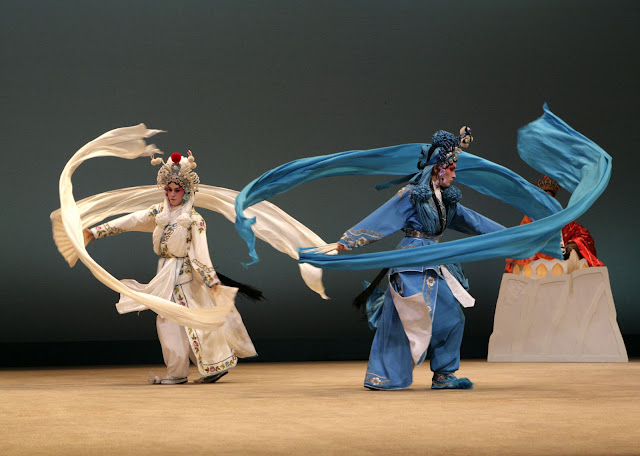
Attended tonight a performance of “The White Snake,” a Beijing Opera, on campus. Somehow I doubt that very many other schools in the US offer such opportunities to study and perform such an East Asian performance art, so that’s quite cool for the students performing. I was skeptical about it being in English, and while it was certainly absurd in some ways, I actually got used to it pretty quickly. I’d still like to see the real thing, though, of course, in China, someday.
It was great fun. Quite makes me eager to see kabuki again. Incidentally, speaking of which, I just found out today about a traditional-style kabuki theatre in Ehime. If I end up in Shikoku this summer, I’ve got to check it out.
I apologize for the haphazard and disorganized nature of this post, but somehow I just can’t seem to find myself in the right frame of mind to write a proper review.
Plot summary:
The sets were relatively spare, but brilliantly done, with stylized white forms lowered from the ceiling to provide a symbolic backdrop indicating the location, whether it be a pagoda to represent being inside a temple complex, or latticed sliding doors to indicate the interior of a mansion. That was not the only set dressing, however – the stage was bordered in a brilliant blue and white cloud design, with matching blue curtains throughout. A cost-efficient tack, sure – this is not the National Beijing Theatre or whatever – but not skimpy or cheap-looking at all.
The costumes were great, too. Some really incredible stuff. Super long sleeves, some amazing headdresses… and the musicians had wonderful, tasteful, dark scholars’robes. I don’t know if I could ever get away with wearing such robes – one would really need to be in the right place and time; can’t just wear them around the streets of NY or Honolulu – but they do look quite fun to wear.
The music was great too; really makes the mood & atmosphere.. all the more necessary when the lines are being performed in English. Though the instruments, and indeed the overall sound, is quite different from kabuki, the music is used in much the same way, punctuating movements and emotional moments, building up in between scenes and providing extra drama, energy, and rhythm for action (combat) scenes. The use of dramatic poses – what would be called mie (見得) in kabuki – was also striking. I don’t think we really do this in Western theatre, except maybe in opera (caveat, I know nothing about opera); even in musicals our actor’s movements are not so closely tied to the music nor so focused on providing these striking moments of drama.
I thought the special effects quite interesting as well, for lack of anything better to call them. For one thing, I love the way boats are handled in Peking opera. There’s no actual boat (or pier or anything) onstage; it’s all implied. When someone gets into the boat, everyone bobs up and down as if the boat is rocking. When the boat is moving, they sway, similarly implying the motion of the boat in the water, and when everyone turns together, it indicates the boat is turning. A stylized convention, to be sure, but a most effective one. When the snake demons summon water spirits to fight for them, the water is represented not by a single long piece of cloth extending across the stage and waved by stagehands, but rather it is represented by individual actors holding and waving individual banners. The fire was done beautifully, and powerfully, with long orange, red, and yellow spans of cloth extending off of folding fans. As they were waved and swirled around by actors in fiery costume, the stage backlit in red, one could hardly imagine a better stylistic way to represent a swirling, roiling fire.
We never see the White Snake in her true form, as a serpent, which could have made for some great costuming or effects, but really it was hardly missed, what with the amazing costumes, music, action, and props, sets and effects.
From what I understand, Beijing opera is an even smaller, i.e. more endangered, art form today than kabuki. Opportunities to see it can’t be too great… so if you do come across the opportunity, I hope you will give it a try. Even if you find it bizarre and exotic, there’s nothing wrong with that. That’s half the appeal for me, to be honest.
Wonder what you would find if you frisked $2 billion of the stimulus money meant to go towards wind power?
Answer: 80% of it is going to foreign companies.
You have got to be kidding me! ABC News reports:
Despite all the talk of green jobs, the overwhelming majority of stimulus money spent on wind power has gone to foreign companies, according to a new report by the Investigative Reporting Workshop at the American University’s School of Communication in Washington, D.C.
Nearly $2 billion in money from the American Recovery and Reinvestment Act has been spent on wind power, funding the creation of enough new wind farms to power 2.4 million homes over the past year. But the study found that nearly 80 percent of that money has gone to foreign manufacturers of wind turbines.
Click the photograph below to watch ABC News’ report:
Jim Hoft – from Gateway Pundit – points out some interesting numbers:
US workers may be laid off but a Chinese company is helping build a massive wind farm in west Texas. The firm will receive $450 million in Stimulus cash. The project will save or create 300 jobs in Texas and 2,000 manufacturing jobs in China. That sounds like a good use of taxpayer dollars, huh?
In the end, large government is extremely inefficient and it’s baffling to think that people actually want to put their faith in it. Honestly, can we consider this $800+ billion stimulus package a complete failure yet? It has done nothing to “stimulate” the economy and what the hell is a “saved” job!? How do you calculate that?
Since the outbreak of the economic recession, China has become more active on the world’s economic stage. In comparison to the United States, it seems that there have been more opportunities for Chinese organizations to make big moves and become more competitive during the recession period. More and more Chinese enterprises are making overseas M&A( merger and acquisition) to gain global market share, especially in the economic downturn. However, the M&A activities in China are immature and full of risk, especially for those cross-border movements. Most of these activities ended in failure. One of the reasons causes the unsuccessful movements is related to the inappropriate attitudes held by the acquirer companies. The managers in the acquirer companies are too optimistic and expect the process to be simple. When facing the challenges after the acquisition, the managers are struggling for the immediate solutions. In addition, most Chinese companies are inexperienced with overseas brand marketing and completely rely on the acquired company’s outdated technology. They never think of what they could bring to and change the target companies except the money. They don’t anticipate that the loyal clients will have a crisis of the brand once it becomes Chinese-owned. As a result, the acquirers should enhance their management skills to make the correct evaluations on the M&A activities. The managers should learn both Chinese and western business practices and understand the existing and potential market thoroughly. Furthermore, the managers in the acquirer companies should improve the Chinese-owned brand awareness in the global market. It’s necessary to gain trust of the local customers and keep them satisfied. The last but not the least, the acquirer companies should learn the leading-technology from different leading companies and initiate their own innovations for the future businesses instead of relying on the acquired companies blindly.
Don’t be so shocked. Aryan is a term abused by Hitler. I found a blog that may help shed a little more light on this.
Once Iran was known as Persia. Persia was an ancient culture. The bible speaks of the Persians.
So why was the name changed?
In 1935, the shah of Iran, who was a Nazi sympathizer and he hated the Jews, decided to rename his country Iran. Read more here… This name Iran, pretty much means “Land of the Aryans.” Were you aware of that?
Mohammad-Rezā Shāh Pahlavi Read more here
There is also an interesting video I found about the Shah and American Presidents.
It would seem their leaders still hold these philosophies to date. This would also explain whyMahmoud Ahmadinejad wants to start a war with Israel.
This is the same man that says the Holocaust was a myth. This is also the same man our American President wants to have a relationship with. This is the same man that the American people made feel welcome and comfortable in this country. I know good public relations….
My father used to say to me growing up in Australia “Don’t go walking in the long grass for you never know, if you will step on a snake.” Snake bites are lethal in Australia if you do not treat them in time.
How many times then, does America allow the venom to be re-injected?
Iran is LESS THAN 12 MONTHS AWAY from developing a powerful Nuclear weapon.
What do you think Iran’s plans will be then?
Do you know what The Collective have said to me about Iran;
“DO NOT TURN YOUR EYES AWAY FROM THE MIDDLE EAST.”
Months ago I wrote a blog about what I saw in a vision. It was of a war in the Middle East. The countries involved in this were the same countries that were near or in Afghanistan. China, Russia, Iran, Israel, America.
I assure you The Collective tell me that Mahmoud Ahmadinejad wants nothing more,
than to start a war with Israel.
Now the media has told the American Public that Russia is selling Uranium to Iran.
I also said months ago in a blog, that Russia and China were secretly speaking.
Russia and China are also doing joint Military Exercises together.
For what purpose?
So, let me remind you how powerful China is becoming. The Australian Federal Reserve wanted to raise their interest rates recently but the Chinese Government said “NO” so it didn’t happen.
America too is so indebted to China with loans, what will be the price we too now pay?
So what then America?
Too many times have we become complacent and comfortable believing that our world rulers knew what is best for us. Even the Shah of Iran said this to the “Blue Eyed People.”
In 1976 Mike Wallace did an Interview with the Shah of Iran.
When I listened to the interview some of what he said was truth.
Especially the parts that people would now call the “Conspiracy Theory.”
All the warning signs were there in 1976.
So why is it that we are still not paying attention? This hate has been going on a long time.
Iran brought weapons from all over the world for what reason?
Iran is now doing business with Russia and this is the same nation who invaded Iran, in the second world war to grab oil. Iran was a Neutral state in WW11.
If you see an
d read the long ugly history here, you will come to understand many things as I have.
Read more here…
Some of these wounds are old and the anger has built up over time.
Let sleeping dogs lie?
I do not think the Iranian Government has forgotten, nor will it ever.
Wake Up.
Love and Blessings
Victoria
China is emerging as 1 on the strong global financial systems since the last two decade and may be the world’s biggest holder of foreign trade reserves with the reserves touching One trillion US dollars. Quite a few nations around the world are interested in company with China and are actively involved in mastering Chinese language language to realize and improve the business opportunities.
Napoleon Bonaparte has as soon as stated that “China is a sleeping giant. Let her lie and sleep for when she awakens she will tremble the world.” Nearly two century once the visionary statement in the legend, China’s dormant economic climate emerged so drastically that economic power that country holds now directly affects and facilitates the pace of global market.
Persons close to the globe and countries are now deliberately continue to trade enterprise relation with world’s fastest growing nation, a nation which is experiencing enormous transition from a central-planned economic climate to a global-oriented current market and has become a dominant player in the international economic climate and economic program. Hence for much better small business knowledge, small business chance and cultural exchange, learning Chinese language has grow to be an all time high with approximately thirty million men and women are studying Chinese language in universities, colleges or private programs.
Chinese language is considered to become a single in the world’s most common languages and is really a easy structured and tonal language wherever an individual word can have distinct meaning depending upon the way it is pronounced. You can find amount of dialects in Chinese language spoken in different province but the popularity is gaining by Mandarin language and this has also been recognized as the official language of China.
To follow the suit, the United States is investing enormous sums in establishing Chinese language understanding schools and passing bills to encourage the Chinese language language programming in schools across the U.S. and cultural exchanges to increase the ties between the two countries.
Despite understanding Chinese language in house countries, folks often prefer to travel to China and invest time there to have acclimatized with their tradition, culture and to gather experiences of being like a Chinese language. With big demands of Chinese language, major cities in China are overcrowded with Mandarin finding out schools and a lot of of which gives superb accommodation facilities, native Chinese language speaking teachers and well qualified people to teach Chinese as foreign language.
Furthermore, students can pick Chinese language language having a hope of getting easy employment in areas like banking, trade, monetary, diplomatic work, academics, news media, content management, tours and travel and quite a few a lot more. Every of these fields is really challenging and provides 1 an sufficient exposure to Chinese language society, culture and tradition.
Hence, if you ever are feeling the urgency of learning Chinese language language and align yourself inside the fast track of organization by learning Chinese language language, this is the right time to begin. In the event you cannot afford to go to China to find out typical Chinese language, you can find plenty of on the internet resources like totally free on-line Chinese language mastering course, audio guidelines and other scripts which can make you perfect in Chinese language language and help you actively participate in several business processes.
Try the Pimsleur Approach
.
Use the this approach to speak Pimsleur Chinese (Mandarin) in only 10 days! Pimsleur courses took over 40 years to develop and excellent. Just sit back and listen while the audio book does the function for you.
.
Every audio book lesson has been scientifically sequenced to rapidly lock language material into your brain once just one listening.
.
You’ll absorb your new language effortlessly with no any reading, writing or pc use.
Related articles
China Expands Language Institutes at US Colleges (abcnews.go.com)
Listening to China | Radio review (guardian.co.uk)
As the first American to study at the Xi Yuan Hospital in Beijing, I was honored to be mentored by some of China’s most experienced doctors. I worked in a setting where Chinese Medicine and Western Medicine were integrated and serious conditions were effectively treated with acupuncture and herbal medicine in the hospital setting. Today in my clinic I still draw on the wisdom and practical tips from my teachers in China. A favorite line of one of my teachers was, “One disease, long life. No disease, short life,” that is, it usually takes an illness for people to learn good self-care which is essential for longevity.
The caterpillar fungus is a traditional medicine that has been widely used as a tonic and/or medicine by the Chinese for hundreds of years. The use of this fungus was relatively unknown in this country until it was credited for the success of Chinese women athletes at the National Games in Beijing, in 1993. Three Chinese track runners set new world records during the Games at three different distances, 10,000 m, 15,000 m and 30,000 m. Their coach, Ma Zunren, attributed the runner’s success to intensive training as well as a stress-relieving tonic prepared from the caterpillar fungus.
In the old days, Chinese people thought that the caterpillar fungus (Dong chong xiz cao) were worms. However, after years of study, it was found that it really is a fruiting body produced by the fungus, Cordyceps sinesis, on dead caterpillars of the moth Hepilus fabricius.
Some people believe the caterpillar fungus cures tuberculosis, coughing, anemia, and back and knee pains. Today, the caterpillar fungus is mainly used as a tonic to increase strength or for rejuvenation after a long serious injury.
I had read about them. I had heard about them. I wanted to see them.
The hutongs of Beijing. You can read a formal definition here, thanks to Wikipedia.
The hutongs are dying off and I wanted the chance to see them, and photograph them. So while the rest of the team set off for The Silk Market, our translator, Maggie, took me to the hutongs. She hung with me for a while, then set me free to wander.
It was my type of afternoon.
There are some hutongs that are more commercial, with small stores and shops selling prints, like above, or trinkets.
But then other areas are so much not so. These are the true hutongs, glimpses into Beijing’s past that still endure.
Pretty incredible.
The people were great, friendly, though guarded. I was shooting mainly with my 70-300mm lens so while they saw me, I wasn’t right on top of them. And, if in the case of one old gal, they didn’t want me to photograph them, I smiled, bowed and said Xie xie!
In a city of 17 million people, 4 million cars and a, as some say, a bike to every person…well, bicycle repairmen are in demand.
Overall, this was a perfect afternoon to me. Wandering around old streets filled with history, camera slung over my shoulder, seeing things that I never would have expected (three guys in chef whites, plus three other guys physically moving a car from one side of the lane to the other to let another car out. Video to come…) and taking some interesting photographs.
As I type this, it’s Monday night in Beijing. Our shoot is done. I’ll be packing up and, tomorrow, headed to the airport. By Tuesday night, I’ll be back in the Great State of New Jersey filled with some fantastic memories.
Headed home a little lighter – I jettisoned some reading material along the way – but also heavier – souvenirs for my girls back home, a new bracelet on my wrist (a personal talisman to ensure a safe, healthy pregnancy for my wife. This woven one from the base of the Great Wall joins the silver one I picked up, and got blessed, in Pinjore, India, last fall) and probably some body weight due to all the dim sum and dumplings I’ve eaten.
Lunches like this.
Yeah, it was that good.
And there’s still so much I want to share…vids that I haven’t been able to upload from here, some incredible people at the Forbidden City, more thoughts from the road.
The Petroleum Refineries Industry report, published annually by Barnes Reports, contains timely and accurate industry statistics, forecasts and demographics. The report features 2010 current and 2011 forecast estimates on the size of the industry (sales, establishments, employment) for the 47 largest world countries, such as Japan, China, India, Russia, Canada, Mexico, Brazil, Argentina, UK, France, Germany, Italy and U.S.. The report also includes industry definition, 5-year historical trends on industry sales, establishments and employment and estimates on up to 10 sub-industries, including natural gas, fuel oil, gasoline, and diesel fuel.
 Another day, another big investment in online video in China. The recipient this time is Qiyi, an online video venture from Chinese search giant Baidu (s BIDU); it’s raised $50 million from Hulu backer Providence Equity Partners.
 By Timothy D. Naegele[1]
 Book description~
 One-month-old South China tiger cub Niuniu is seen at a zoo in Luoyang, Henan province, February 20, 2010. The Chinese New Year began on February 14th and according to the Lunar calendar, it is the Year of the Tiger. REUTERS/China Daily (CHINA – Tags: ANIMALS SOCIETY) CHINA OUT. NO COMMERCIAL OR EDITORIAL SALES IN CHINA
![Reblog this post [with Zemanta]](http://img.zemanta.com/reblog_e.png?x-id=2da95459-ea52-45cc-9e02-a085acf41b53)





 Honestly, can we consider this $800+ billion stimulus package a complete failure yet? It has done nothing to “stimulate” the economy and what the hell is a “saved” job!? How do you calculate that?
 This is the same man that says the Holocaust was a myth. This is also the same man our American President wants to have a relationship with. This is the same man that the American people made feel welcome and comfortable in this country. I know good public relations….
My father used to say to me growing up in Australia “Don’t go walking in the long grass for you never know, if you will step on a snake.” Snake bites are lethal in Australia if you do not treat them in time.
How many times then, does America allow the venom to be re-injected?
Iran is LESS THAN 12 MONTHS AWAY from developing a powerful Nuclear weapon.
What do you think Iran’s plans will be then?
Do you know what The Collective have said to me about Iran;
“DO NOT TURN YOUR EYES AWAY FROM THE MIDDLE EAST.”
Months ago I wrote a blog about what I saw in a vision. It was of a war in the Middle East. The countries involved in this were the same countries that were near or in Afghanistan. China, Russia, Iran, Israel, America.
This is the same man that says the Holocaust was a myth. This is also the same man our American President wants to have a relationship with. This is the same man that the American people made feel welcome and comfortable in this country. I know good public relations….
My father used to say to me growing up in Australia “Don’t go walking in the long grass for you never know, if you will step on a snake.” Snake bites are lethal in Australia if you do not treat them in time.
How many times then, does America allow the venom to be re-injected?
Iran is LESS THAN 12 MONTHS AWAY from developing a powerful Nuclear weapon.
What do you think Iran’s plans will be then?
Do you know what The Collective have said to me about Iran;
“DO NOT TURN YOUR EYES AWAY FROM THE MIDDLE EAST.”
Months ago I wrote a blog about what I saw in a vision. It was of a war in the Middle East. The countries involved in this were the same countries that were near or in Afghanistan. China, Russia, Iran, Israel, America.
![Reblog this post [with Zemanta]](http://img.zemanta.com/reblog_e.png?x-id=13e1a22b-914f-4154-b8b7-17356bb796c5)


