
Attended tonight a performance of “The White Snake,” a Beijing Opera, on campus. Somehow I doubt that very many other schools in the US offer such opportunities to study and perform such an East Asian performance art, so that’s quite cool for the students performing. I was skeptical about it being in English, and while it was certainly absurd in some ways, I actually got used to it pretty quickly. I’d still like to see the real thing, though, of course, in China, someday.
It was great fun. Quite makes me eager to see kabuki again. Incidentally, speaking of which, I just found out today about a traditional-style kabuki theatre in Ehime. If I end up in Shikoku this summer, I’ve got to check it out.
I apologize for the haphazard and disorganized nature of this post, but somehow I just can’t seem to find myself in the right frame of mind to write a proper review.
Plot summary:
The sets were relatively spare, but brilliantly done, with stylized white forms lowered from the ceiling to provide a symbolic backdrop indicating the location, whether it be a pagoda to represent being inside a temple complex, or latticed sliding doors to indicate the interior of a mansion. That was not the only set dressing, however – the stage was bordered in a brilliant blue and white cloud design, with matching blue curtains throughout. A cost-efficient tack, sure – this is not the National Beijing Theatre or whatever – but not skimpy or cheap-looking at all.
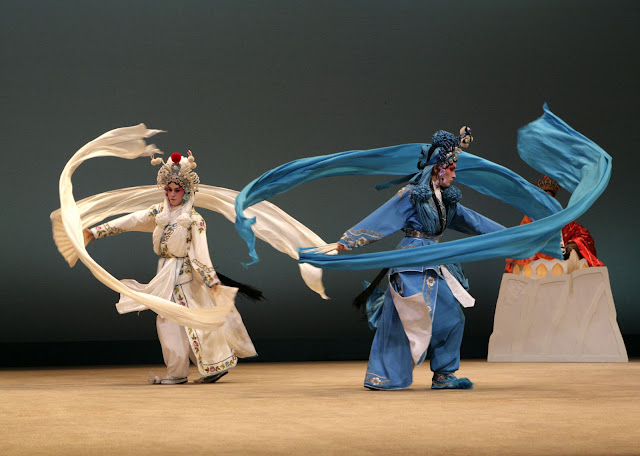
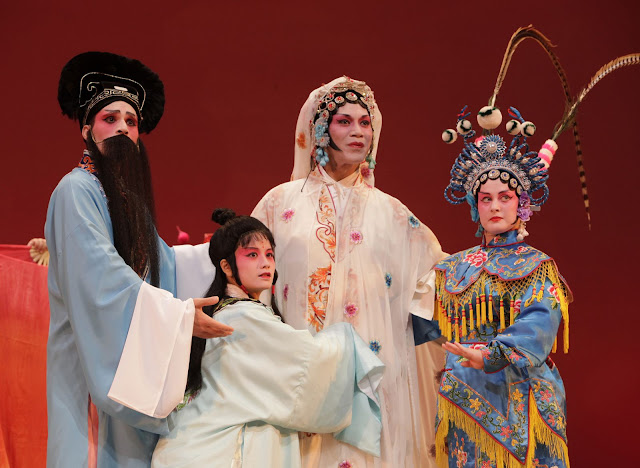
The costumes were great, too. Some really incredible stuff. Super long sleeves, some amazing headdresses… and the musicians had wonderful, tasteful, dark scholars’robes. I don’t know if I could ever get away with wearing such robes – one would really need to be in the right place and time; can’t just wear them around the streets of NY or Honolulu – but they do look quite fun to wear.
The music was great too; really makes the mood & atmosphere.. all the more necessary when the lines are being performed in English. Though the instruments, and indeed the overall sound, is quite different from kabuki, the music is used in much the same way, punctuating movements and emotional moments, building up in between scenes and providing extra drama, energy, and rhythm for action (combat) scenes. The use of dramatic poses – what would be called mie (見得) in kabuki – was also striking. I don’t think we really do this in Western theatre, except maybe in opera (caveat, I know nothing about opera); even in musicals our actor’s movements are not so closely tied to the music nor so focused on providing these striking moments of drama.
I thought the special effects quite interesting as well, for lack of anything better to call them. For one thing, I love the way boats are handled in Peking opera. There’s no actual boat (or pier or anything) onstage; it’s all implied. When someone gets into the boat, everyone bobs up and down as if the boat is rocking. When the boat is moving, they sway, similarly implying the motion of the boat in the water, and when everyone turns together, it indicates the boat is turning. A stylized convention, to be sure, but a most effective one. When the snake demons summon water spirits to fight for them, the water is represented not by a single long piece of cloth extending across the stage and waved by stagehands, but rather it is represented by individual actors holding and waving individual banners. The fire was done beautifully, and powerfully, with long orange, red, and yellow spans of cloth extending off of folding fans. As they were waved and swirled around by actors in fiery costume, the stage backlit in red, one could hardly imagine a better stylistic way to represent a swirling, roiling fire.
We never see the White Snake in her true form, as a serpent, which could have made for some great costuming or effects, but really it was hardly missed, what with the amazing costumes, music, action, and props, sets and effects.
From what I understand, Beijing opera is an even smaller, i.e. more endangered, art form today than kabuki. Opportunities to see it can’t be too great… so if you do come across the opportunity, I hope you will give it a try. Even if you find it bizarre and exotic, there’s nothing wrong with that. That’s half the appeal for me, to be honest.

No comments:
Post a Comment